IRS GROUP EXEMPTION MANAGEMENT
See every chapter. Keep local autonomy.
Manage your group exemption through one connected system that gives your central organization the visibility and workflows it needs—while local chapters keep control of their day-to-day operations.
The operating burden is increasing
Revenue Procedure 2026-8 changes what central organizations need to manage to maintain a group exemption. The practical challenge is not simply understanding the rules — it is building a repeatable process to collect, review, document, and report chapter information every year.
Existing group rulings have a transition period ending January 22, 2027. Organizations should work with their own legal and tax advisors to understand their specific structure and timing. Review IRS Revenue Procedure 2026-8.
Without Givebacks
Spreadsheets, email chains, outdated officer information, disconnected systems, missing information, manual follow-up, and limited filing-status or financial visibility can obscure the current picture.
With Givebacks
One organizational hierarchy connects people, records, and structured workflows. Central teams can track communications and education, surface exceptions, and use clean reporting while local leaders retain day-to-day control.
Could you prove your group exemption process today?
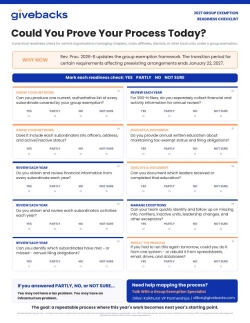
Take the 2-minute 2027 Group Exemption Readiness Check.
See whether your organization has the people, data, documentation, and annual processes in place to manage your subordinate network — and quickly spot the areas that may need attention before the transition period for certain requirements ends January 22, 2027.
Get the Free Readiness Checklist
10 questions • Takes about 2 minutes • Free PDF
Not sure how you’d answer #6? You’re not alone.
The CFO Guide to the New IRS Group Exemption Requirements
The rules for maintaining a group exemption have changed. Our CFO Brief translates the new requirements into practical guidance for central organizations, including what is required, what remains unclear, and what finance and compliance teams should be doing now.
What changed
Understand the key requirements established under IRS Revenue Procedure 2026-8.
What to prepare for
See what central organizations should be preparing for as the transition period approaches its end.
What to build now
Learn how to establish repeatable processes for annual supervision, documentation, and reporting across subordinate organizations.
Built for CFOs, finance leaders, executive directors, and national organizations managing subordinate chapters.
Central visibility. Local autonomy. One connected ecosystem.
A single organizational hierarchy connects the central organization to regions or districts where applicable, then to chapters, clubs, affiliates, and local officers — with role-based permissions and local autonomy.
Six capabilities. One connected operating model.
Know who every chapter is
Roster, EINs, officers, permissions, contacts, and current organizational status.
Know who’s falling behind
Structured workflows surface missing information, exceptions, approvals, and follow-up.
See the financial picture
Collect and roll up financial information and transaction data across subordinate units.
Track annual filings
Maintain 990 and filing-status visibility, and identify chapters that require follow-up.
Educate once. Track everywhere.
Deliver guidance and policy acknowledgments to chapter leaders, then track completion.
Report without rebuilding the spreadsheet
Use dashboards and clean exports for leadership, advisors, and recurring governance processes.
From once-a-year scramble to a sustainable operating cycle
This year’s work becomes next year’s starting point.
- Baseline — Roster, EINs, officers, and status.
- Collect — Financial information and filing status.
- Educate — Guidance and completion.
- Review — Exceptions and follow-up.
- Report — Clean data for governance.
- Sustain — Repeat with one system of record.
Give every chapter a shared rhythm and give central teams a consistent way to see what needs attention before the annual process becomes urgent — without rebuilding the compliance process every year.
Solve the requirement. Improve the organization.
Givebacks can extend beyond group-exemption workflows into technology local organizations use every day — while creating better visibility for the central organization. Local teams can adopt the capabilities that fit their operations; they do not need to use every product.
Payments and dues, fundraising, events and ticketing, communications, membership and organization management, online stores and point of sale, and financial and transactional reporting can all be part of a broader connected operating platform.
Central visibility. Local autonomy. One connected ecosystem.
Technology infrastructure for decentralized organizations
Givebacks already supports technology infrastructure across 14K+ volunteer-led organizations. This current public platform figure does not refer specifically to Group Exemption Management customers.
Group exemption management, explained
What changed with the IRS group exemption rules?
Revenue Procedure 2026-8 modernizes the IRS group exemption program and increases the ongoing responsibilities central organizations must manage across their subordinate organizations. For large chapter networks, the operational challenge is maintaining accurate subordinate information, financial visibility, documented education, filing status, and recurring reporting processes at scale.
What is the January 22, 2027 group exemption deadline?
The IRS established a transition period for preexisting group exemption letters that ends January 22, 2027. Central organizations with existing group rulings should work with their legal and tax advisors to understand how the new procedures apply to their specific structure and timing.
What is IRS Form 15644?
Form 15644, Supplemental Group Ruling Information, is used by central organizations to provide required information for maintaining a group exemption. The IRS generally requires the annual submission during the period 30 to 90 days before the close of the central organization’s accounting period.
What information should a central organization track about subordinate organizations?
Depending on the organization and applicable requirements, central teams may need reliable visibility into subordinate rosters, EINs, officers, active or inactive status, financial information, filing status, compliance communications, education completion, and exceptions requiring follow-up.
How can technology help manage a group exemption?
Technology can turn a manual annual scramble into a repeatable operating process by connecting subordinate records, forms, approvals, education, financial data, communications, filing-status tracking, exceptions, dashboards, and exports in one system.
Can a central organization maintain visibility without taking away chapter autonomy?
Yes. A hierarchical platform can give the central organization role-based oversight and reporting while allowing local chapters or affiliates to continue managing their own officers, finances, programs, fundraising, events, and day-to-day operations.
Is Givebacks a legal or tax advisor?
No. Givebacks provides technology and operational infrastructure for multi-chapter organizations. Organizations should continue to rely on their own legal and tax advisors for interpretation of IRS requirements and advice specific to their circumstances.